East Village · New York
Things to Do in the East Village: Best Spots on a Self-Guided Walking Tour
Where to go, what to skip
Rafaël · · 2 hours · ~1.5 miles · 10 stops
- 1. Cooper Union
- 2. McSorley's Old Ale House
- 3. Stuyvesant Street
- 4. St. Mark's Church in-the-Bowery
- 5. Village East by Angelika
- 6. Veselka
- 7. St. Marks Place
- 8. Tompkins Square Bagels
- 9. Tompkins Square Park
- 10. Katz's Delicatessen
The East Village is where New York City kept its edge. While the West Village went upscale, the East Village stayed scrappy: dive bars next to ramen shops, record stores under tenements, community gardens tucked between buildings. This is one of the most walkable, character-dense neighborhoods in Manhattan.
The East Village sits between 14th Street and Houston Street, east of Broadway. To the west is Greenwich Village, to the south the Lower East Side, to the north Gramercy. This route stays inside the East Village proper and connects the most worth-your-time spots on foot, in walking order.
Whether you’re visiting for the first time or you live here and want to see your neighborhood with fresh eyes, this walk covers the highlights that matter: Cooper Union, the oldest bar in the city, a church where Allen Ginsberg read poetry, the Physical Graffiti buildings on St. Marks Place, Tompkins Square Park, and Katz’s Deli.
The walk covers 10 stops across 1.5 miles. No rushed group tour, no bus that barely slows down. Just you, your pace, and the streets that made the neighborhood what it is.
Take this walk with audio narration →
At a Glance
- Distance: ~1.5 miles
- Time: 2 hours with stops (60 minutes walking only)
- Start: Cooper Union at Astor Place (6 train at Astor Place)
- End: Katz’s Delicatessen on Houston Street
- Best for: First-timers, history lovers, music fans, anyone who wants to walk without fighting crowds
- Best time: Weekday mornings for quiet; weekend afternoons for street energy; evenings for bars and live music
- Best season: Spring (April to June) or fall (September to November)
- Difficulty: Easy, mostly flat sidewalks
- What it covers: Abolitionist history, literary landmarks, punk rock heritage, Ukrainian food, community gardens
1. Cooper Union
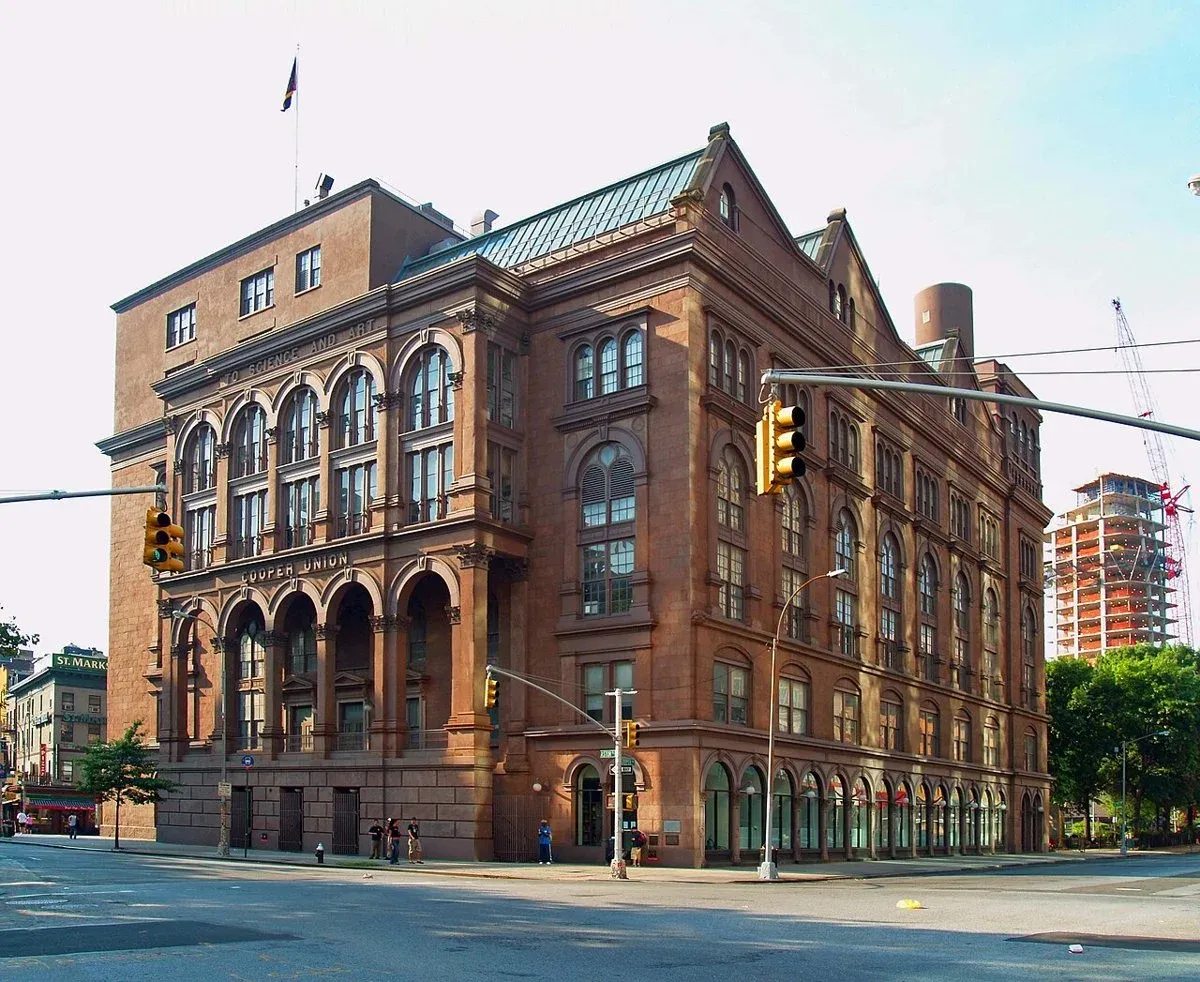
Start here, at the corner of Astor Place and Third Avenue.
The Cooper Union for the Advancement of Science and Art was founded in 1859 by Peter Cooper, an industrialist who believed education should be free and open to all, regardless of race, religion, gender, or social class. The school offered free tuition from its founding until 2014, when financial pressures forced it to charge undergraduate tuition for the first time in its history. A 2018 announcement restored full-tuition scholarships for most admitted students.
The Foundation Building, the brownstone with the grand arched entrance, is the oldest structure on campus and one of the oldest steel-framed buildings in the United States. It opened in 1859, the same year the school was founded.
On February 27, 1860, Abraham Lincoln delivered his “Right Makes Might” speech in the Great Hall. The speech, which argued against the expansion of slavery, helped propel Lincoln to the presidency later that year. The Great Hall is still used for public events and lectures.
Look up at the arched windows and the ironwork. Then walk east on East 7th Street.
2. McSorley’s Old Ale House
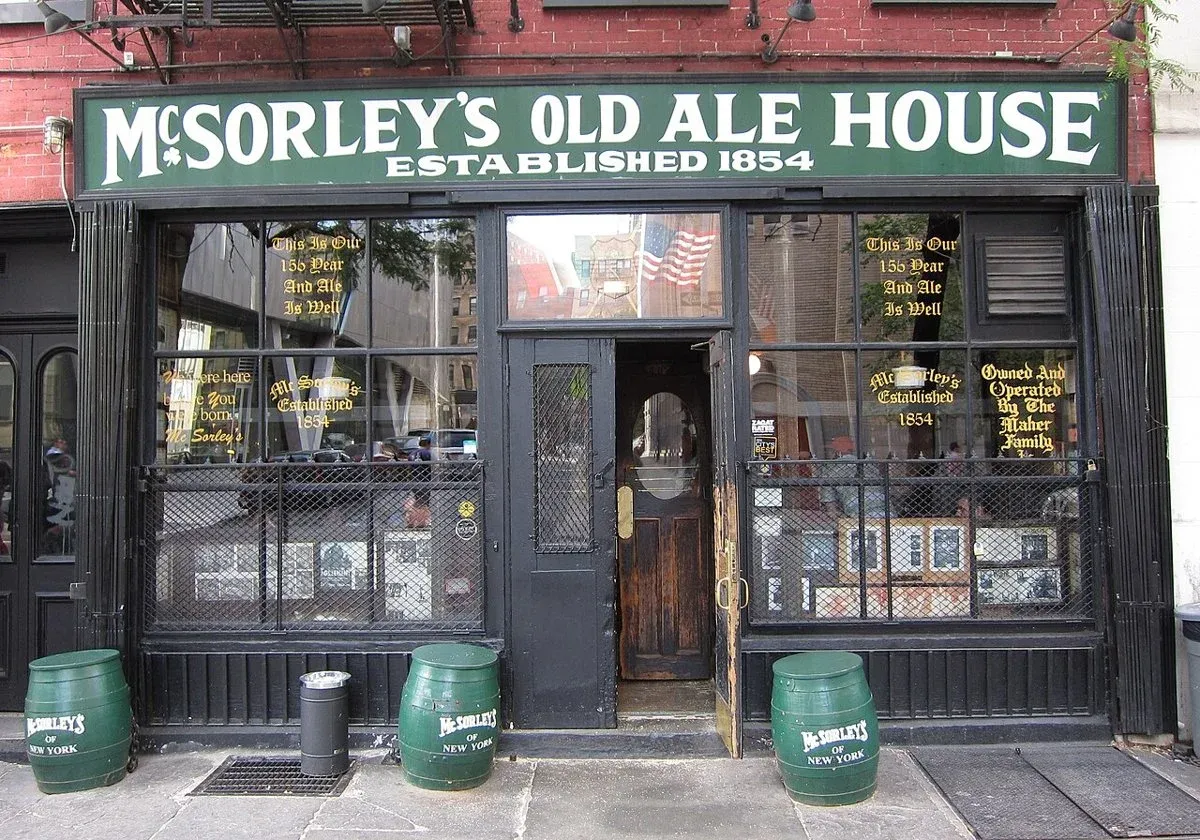
Two blocks east on East 7th Street, you’ll find McSorley’s at 15 East 7th Street.
McSorley’s opened in 1854, making it one of the oldest continuously operating bars in New York City. The sawdust on the floor, the gas lamps, the wanted posters on the walls, none of it is for show. This is what the bar looked like in the 19th century, and it stayed that way.
Women were not allowed inside until 1970, when a lawsuit forced the bar to admit them. The menu is simple: light beer or dark beer, cheese plates, burgers. Cash only. No cocktails. No complaints.
What to know: the bar gets packed on weekend evenings. Come midday if you want to actually sit. The two beers are good, not great. You’re here for the room, not the craft beer selection.
3. Stuyvesant Street
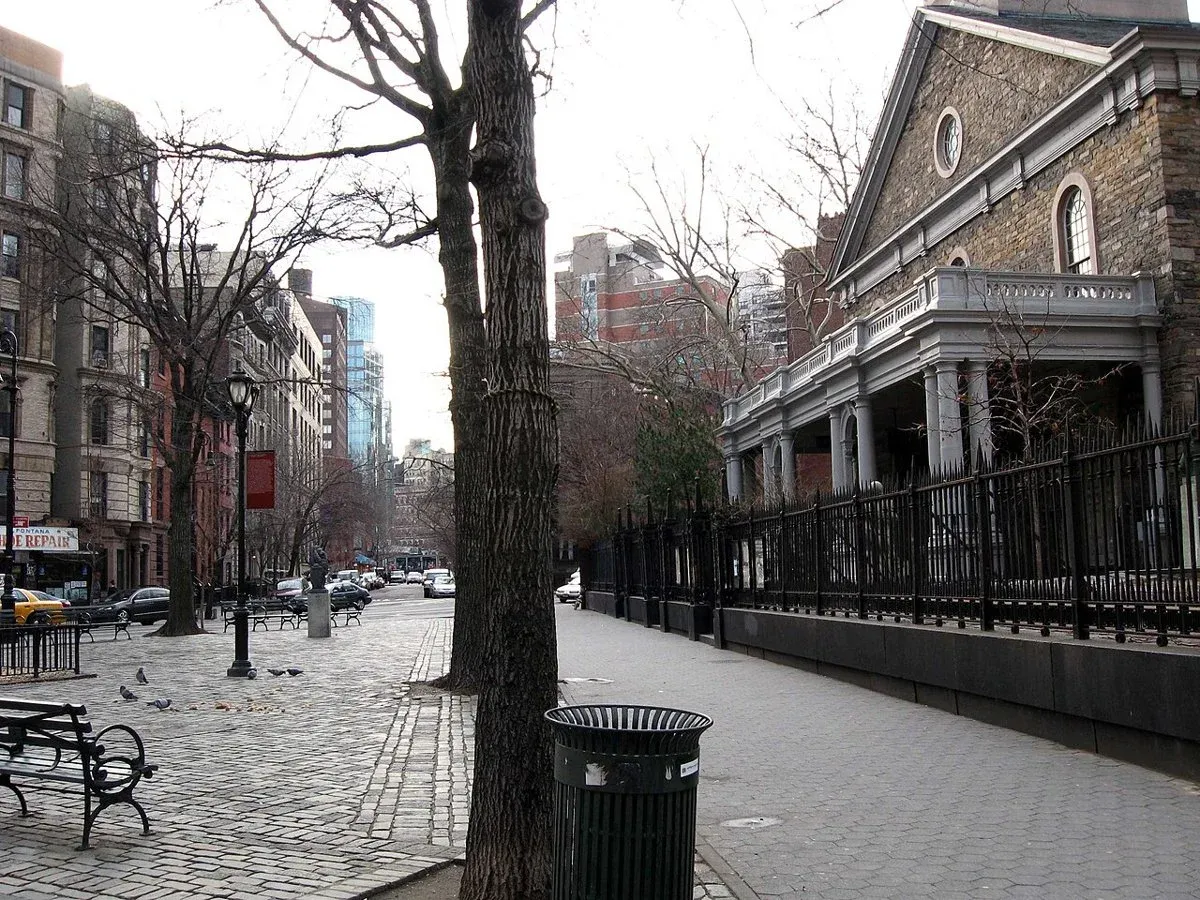
Walk back west and look for Stuyvesant Street, the diagonal block running between Third Avenue and East 10th Street.
Stuyvesant Street is the only street in Manhattan that runs true east-west, following the original property line of Peter Stuyvesant’s 17th-century farm. Every other “east-west” street in the city follows the grid laid out in 1811, which is actually tilted 29 degrees from true north.
The Federal-style row houses on Stuyvesant Street date to the 1820s and 1830s. The street is quiet, tree-lined, and feels completely separate from the avenues on either end. Walk it slowly. It takes two minutes.
4. St. Mark’s Church in-the-Bowery
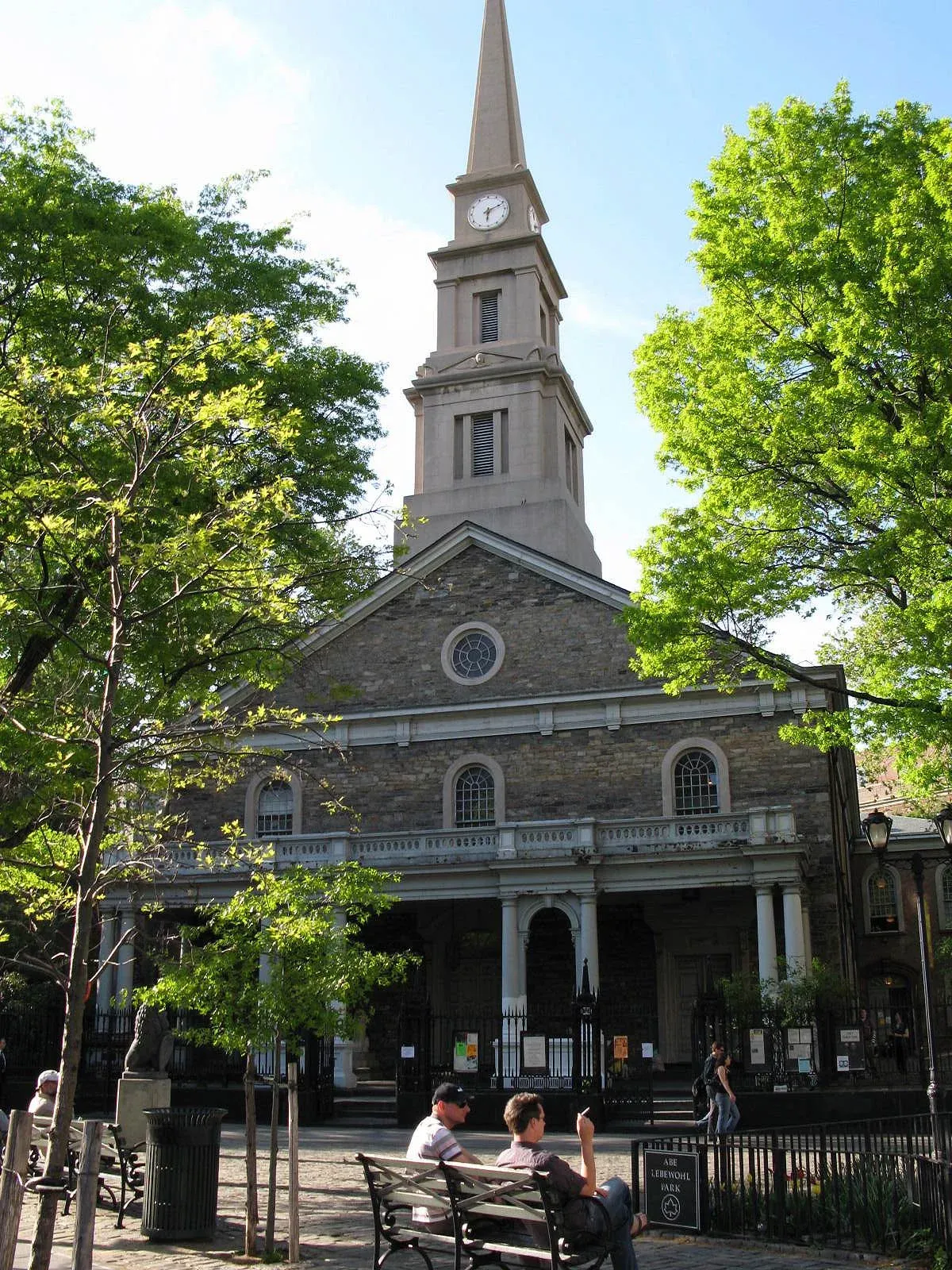
At the top of Stuyvesant Street, you’ll see St. Mark’s Church at 131 East 10th Street.
The church was built in 1799 on the site of Peter Stuyvesant’s private chapel. Stuyvesant himself is buried in the churchyard, along with several generations of his descendants. The church’s Greek Revival steeple was added in 1828, the cast-iron fence around the yard went up in 1836.
In the 1960s and 1970s, St. Mark’s became a center for avant-garde poetry and performance. Allen Ginsberg, Patti Smith, and Sam Shepard all performed here. The Poetry Project, founded in 1966, still hosts readings in the church sanctuary.
If the church is open, walk in. The sanctuary is simple, light, and quiet. The Poetry Project’s event calendar is posted near the entrance.
5. Village East by Angelika
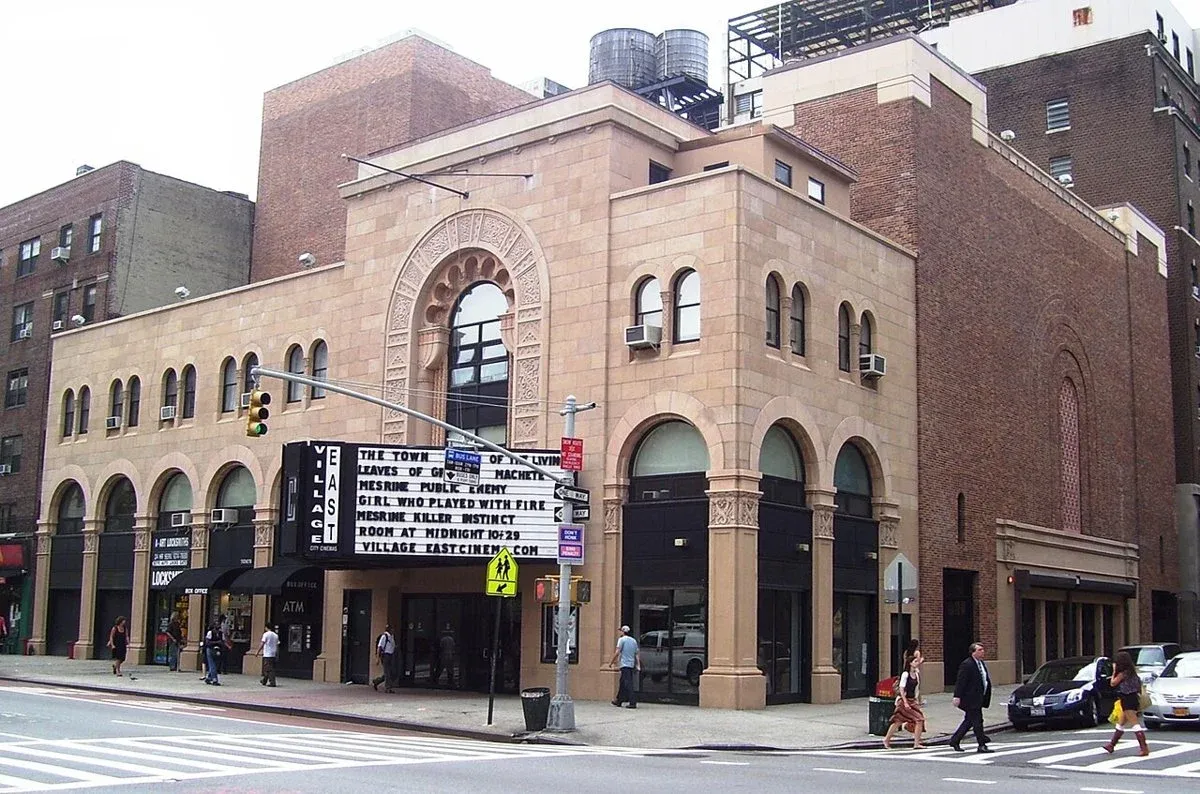
Walk south on Second Avenue to 189 Second Avenue, between 11th and 12th Streets.
Village East by Angelika is a movie theater, but the building is what matters. It opened in 1926 as the Yiddish Art Theatre, built to showcase Yiddish-language plays and vaudeville. The interior is a Moorish Revival fantasy: ornate plasterwork, arched ceilings, painted columns, and a main auditorium that feels like a Spanish palace.
The theater closed in the 1990s, then reopened as a multiplex. The original auditorium, now Theater 1, is the only screen that preserves the 1926 interior. Buy a ticket for whatever is showing in Theater 1, or ask at the box office if you can peek inside during the day.
The exterior is restrained brick; the interior is the spectacle.
6. Veselka
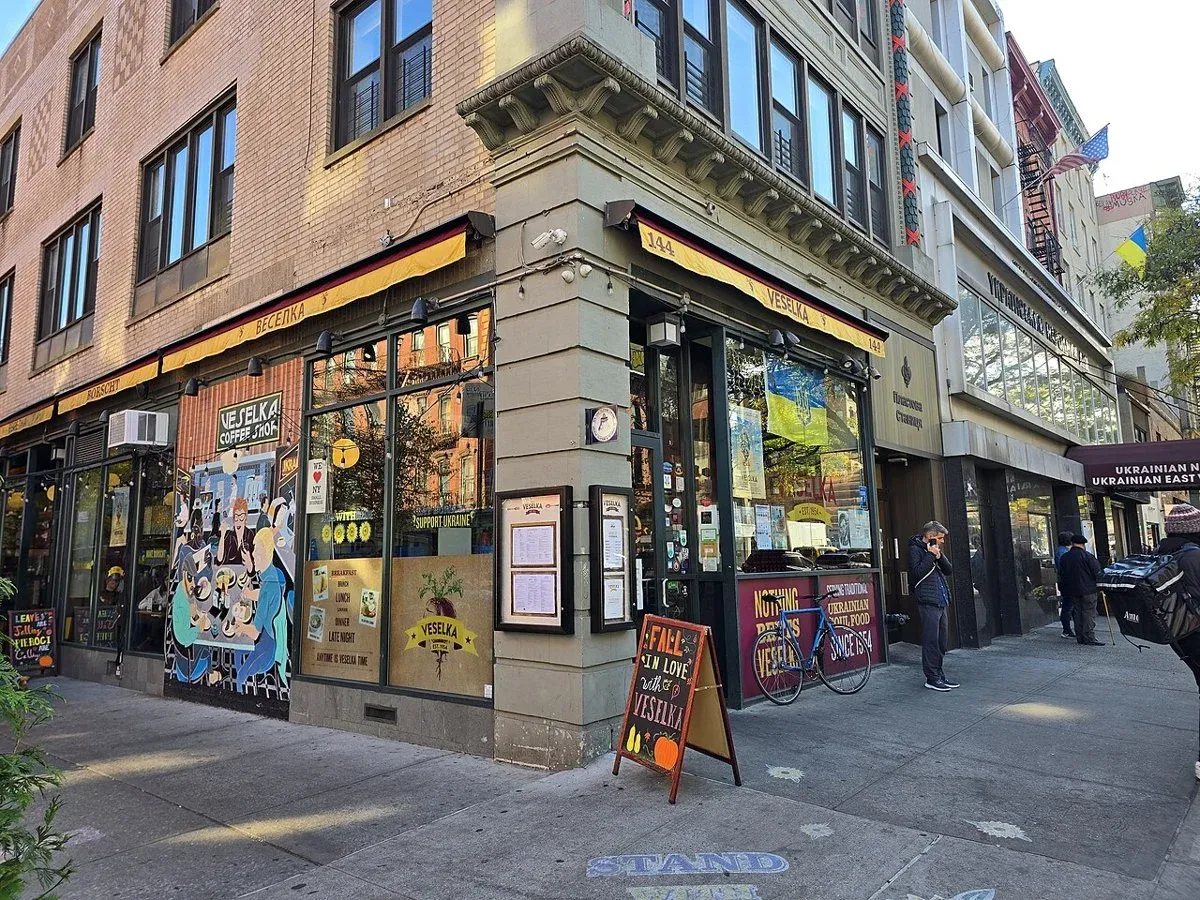
Walk south to 144 Second Avenue at 9th Street.
Veselka is a 24-hour Ukrainian diner that opened in 1954. The neighborhood around Tompkins Square Park was the center of New York’s Ukrainian immigrant community for most of the 20th century, and Veselka is the last high-profile holdout from that era.
The menu is pierogies, borscht, kielbasa, blintzes, challah French toast, and strong coffee. Prices are reasonable, portions are large, and the counter seats are first-come, first-served. The weekend brunch line can stretch down the block, but turnover is fast.
Stop in for coffee and a pierogi plate. Fuel for the rest of the walk.
7. St. Marks Place
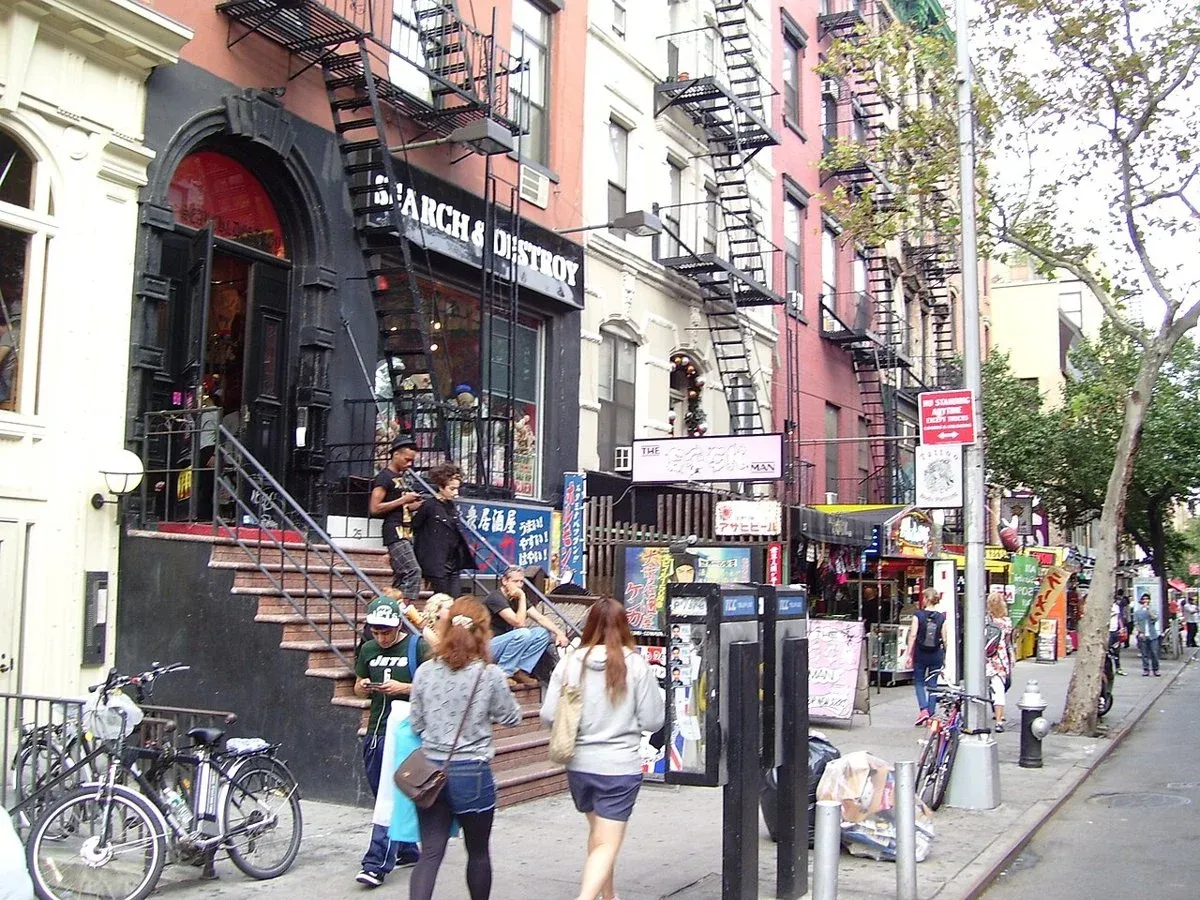
Walk south on Second Avenue to St. Marks Place, the stretch of 8th Street between Third Avenue and Avenue A.
St. Marks Place has been the commercial heart of the East Village since the 1960s. The block was home to punk clubs, record stores, vintage shops, and dive bars. Some of that is still here. A lot of it is gone, replaced by bubble tea shops and fast-casual chains.
What’s worth your time: the Physical Graffiti buildings at 96 and 98 St. Marks Place, the two tenements used on the cover of Led Zeppelin’s 1975 album. The buildings are still there, still residential, and still recognizable. Stand on the south side of the street for the full view.
Trash and Vaudeville, the punk and goth clothing shop, closed in 2016 after 46 years. St. Mark’s Bookshop closed in 2016. Manic Panic, the hair dye shop, is still here. Search and Destroy vintage is still here. The block is a mix of holdouts and new tenants.
Walk it once for the album cover. Walk it twice if you want to dig into the shops that remain.
8. Tompkins Square Bagels
Walk east on St. Marks Place to Avenue A, then south to 165 Avenue A near 10th Street.
Tompkins Square Bagels opened in 1991 and has been serving some of the best bagels in the city ever since. The bagels are hand-rolled, kettle-boiled, and baked fresh every day. The shop is small, the menu is simple, the line moves fast.
Order a bagel with cream cheese and lox, or any of the house spreads. Eat it on the bench outside or take it into Tompkins Square Park, which is your next stop.
9. Tompkins Square Park
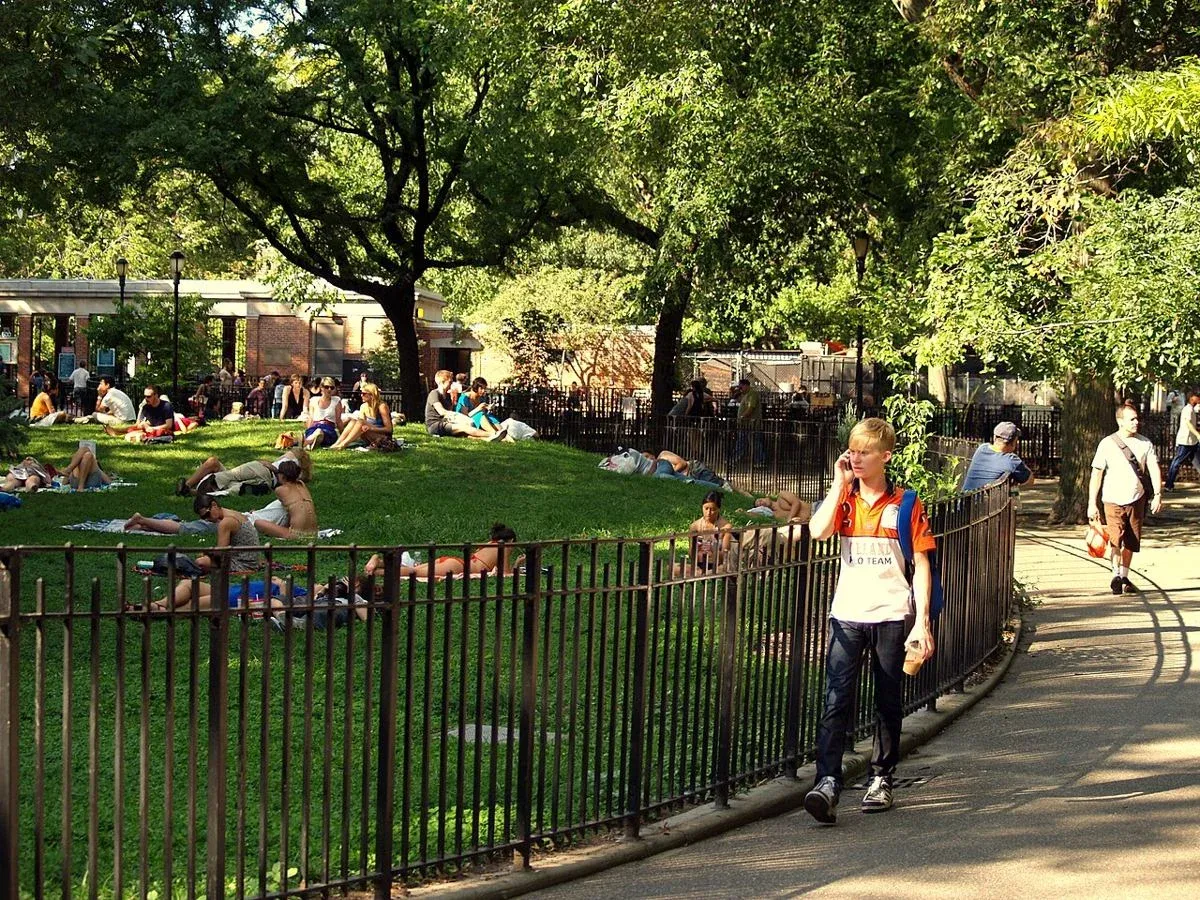
Walk south on Avenue A to Tompkins Square Park, the ten-acre green space between 7th and 10th Streets, Avenue A and Avenue B.
The park opened in 1834 and has been the center of East Village street life ever since. In the 1980s, the park became a tent city for the homeless. In 1988, police evicted the encampments, sparking riots that lasted several nights. The park was closed for renovations in 1991 and reopened in 1992 with a midnight curfew, which remains in place.
Today the park is a neighborhood hub: dog runs, playgrounds, basketball courts, a small bandshell, and benches under old trees. The Hare Krishna tree on the north side of the park marks the spot where A.C. Bhaktivedanta Swami Prabhupada held the first outdoor Hare Krishna chant in the United States in 1966. A plaque marks the location.
Sit for a few minutes. The park is where the neighborhood comes to sit, too.
10. Katz’s Delicatessen
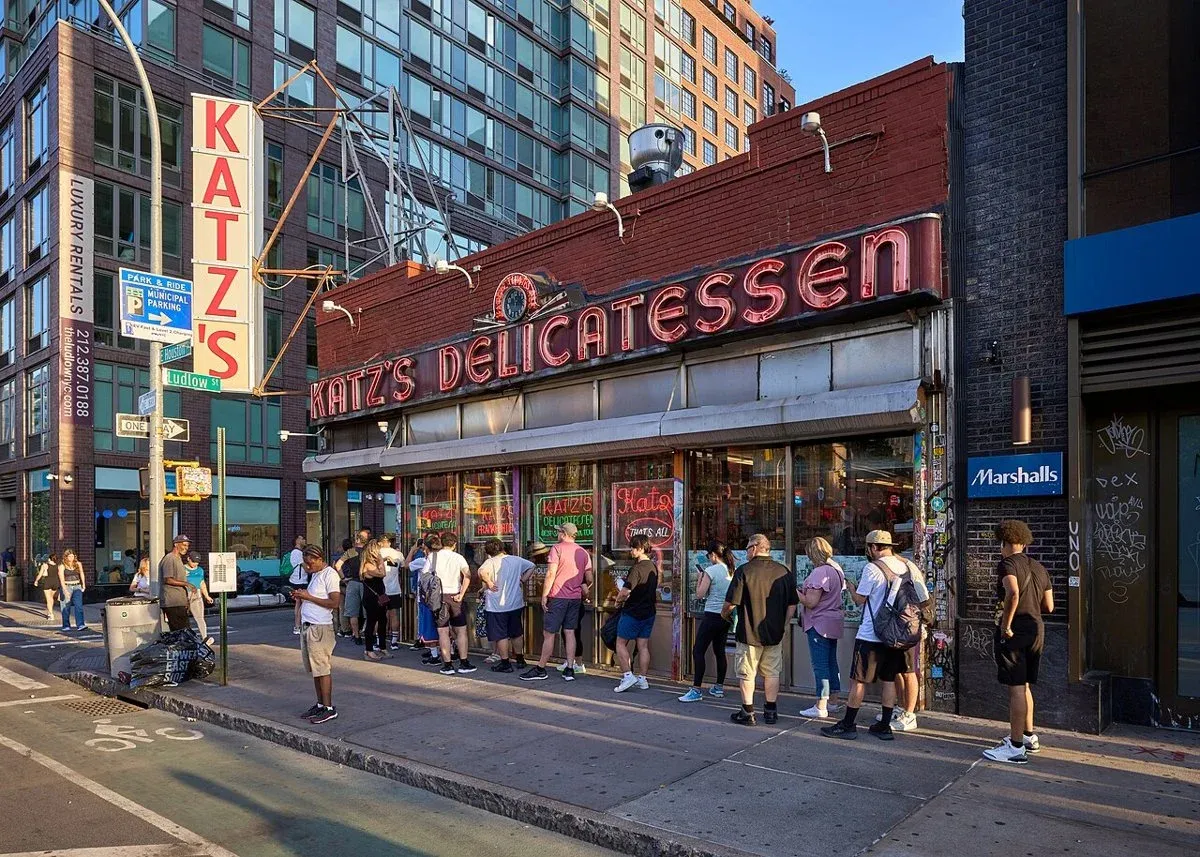
Walk south on Avenue A to Houston Street, then west on Houston to 205 East Houston Street, at the corner of Ludlow.
Katz’s Delicatessen opened in 1888 and has been serving pastrami sandwiches ever since. The “Send a Salami to Your Boy in the Army” slogan dates to World War II. The dining room is vast, cafeteria-style, and chaotic. You get a ticket when you walk in, order at the counter, and pay when you leave. Do not lose the ticket.
The pastrami sandwich is the reason you’re here. It’s hand-carved, piled high, served on rye with mustard. It’s expensive, it’s enormous, and it’s worth it. Share one if you can.
The “I’ll have what she’s having” table from When Harry Met Sally is marked with a sign. The scene was filmed here in 1989. It’s a quick photo stop, but the pastrami is the real attraction.
This is where the walk ends. Take the F train at Second Avenue or the J/M/Z at Essex Street back to wherever you’re going next.
What I’d Skip
Every guide tells you what to see. Almost none tell you what’s not worth the trouble. Here’s what I’d walk past.
St. Marks Place on a Saturday night. The street is packed, loud, and hard to navigate. Come midday if you want to see the shops and the album cover buildings without fighting the crowd.
Any “punk bar” that opened after 2010. The real ones closed decades ago. If a bar has a sign that says “punk bar,” it’s not one.
Brunch at Veselka on a Sunday morning. The line is long, the wait is real, and the food is the same as it is on a Tuesday at 10 AM. Come any other time.
Where to Eat Along the Route
Four spots, in the order you’ll pass them.
-
Veselka (144 Second Ave) for pierogies and borscht. Ukrainian comfort food, open 24 hours, no reservations.
-
Tompkins Square Bagels (165 Avenue A) for the best bagel in the neighborhood. Hand-rolled, kettle-boiled, perfect.
-
Superiority Burger (119 Avenue A) for a vegetarian burger that converts meat-eaters. Simple menu, big flavor, counter service.
-
Katz’s Delicatessen (205 East Houston St) for the pastrami sandwich. The end of the walk, the end of your appetite.
Practical Tips
Best Time of Day
Weekday mornings are quietest for photos and walking. Weekend afternoons bring street energy and crowds on St. Marks Place. Evenings are best if you want to end at a bar or live music venue.
Best Season
Spring (April to June) and fall (September to November) are ideal. Summer is lively but hot. Winter is fine if you layer up; the streets are less crowded and the neighborhood looks great in low light.
Rain Plan
Most of the route is outdoors, but you have indoor options at each stage. McSorley’s, Village East by Angelika, Veselka, and Katz’s all work as rain breaks. Bring a compact umbrella.
Accessibility
Most sidewalks on this route are flat and accessible. The subway stop at Astor Place has elevator access. Katz’s Delicatessen has a ramp entrance on Ludlow Street.
With Kids
Tompkins Square Park is the best stop for kids: playgrounds, a dog run, and open space. Skip McSorley’s (it’s a bar) and St. Marks Place after dark. Katz’s is loud but family-friendly.
Getting There
Take the 6 train to Astor Place. From Midtown, the trip takes about 10 minutes. Exit onto Astor Place and you’re at the start.
What to Wear
Comfortable walking shoes. The route is mostly flat, but you’ll be on your feet for two hours. Layers are smart in spring and fall.
Restrooms
Public restrooms are scarce. Veselka, Katz’s, and any Starbucks will let customers use theirs. Tompkins Square Park has public restrooms near the Avenue A entrance.
Take This Walk with Audio
You’ve got the route. You know the stops. But reading about a place and hearing its story while you’re standing in it are two different things.
The East Village audio walk on Escapade is narrated by a local creator who knows these streets. At each stop, you get the history, the context, and the details that don’t fit in a blog post.
The route is flexible. Skip stops, reorder them, go at your own pace. No group to keep up with, no schedule to follow. Just you, your headphones, and the neighborhood.
Nearby Neighborhoods
Greenwich Village sits to the west, with more residential blocks and NYU’s campus. SoHo is southwest across Houston Street. The Lower East Side is south of Houston, with tenement museums and nightlife. Chelsea is a short walk north of 14th Street. All four connect naturally to this route.
See also: Self-Guided Walking Tours in NYC
Frequently Asked Questions
How long does an East Village walking tour take?
Plan for 2 hours if you stop at each landmark. Walking the route without stops takes about 60 minutes.
What’s the difference between the East Village and the West Village?
The East Village is east of Broadway, grittier, with Ukrainian food and punk history. The West Village is west of Sixth Avenue, upscale, with Federal townhouses and hidden gardens. Both are walkable in one day.
What are the best things to do in the East Village?
Cooper Union, McSorley’s Old Ale House, St. Mark’s Church, the Physical Graffiti buildings on St. Marks Place, Tompkins Square Park, and Katz’s Delicatessen. All of them are on this route.
Where is the best bagel in the East Village?
Tompkins Square Bagels at 165 Avenue A. Hand-rolled, kettle-boiled, worth the short walk from St. Marks Place.
Is the East Village safe at night?
Yes. The East Village is generally safe, with well-lit streets and consistent foot traffic through the evening. Standard city awareness applies.
Can I do the East Village and West Village in one day?
Yes. Finish this walk, grab lunch at Katz’s, then walk west across Broadway into the West Village. Budget 4–5 hours total for both.
Where to start an East Village walk?
Cooper Union at Astor Place, on the 6 train. It’s the natural anchor for the neighborhood and sets you up to walk east through the best blocks.